My title page contents
Showing posts with label Cubans. Show all posts

Tuesday, June 14, 2016

FCF Archives - Brothers in Thought: Oscar Elías Biscet and Oswaldo Payá Sardiñas

Twelve years ago at Florida International University, the coordinator of the Free Cuba Foundation, Neri Martinez published an essay reflecting on the nonviolent activism of two Cubans. At the time Dr. Oscar Elías Biscet was in prison serving a 25 year prison sentence and Oswaldo Payá Sardiñas was free, although most of the leaders in his movement were in prison, alongside Oscar Elías. The Notes from the Cuban Exile Quarter blog yesterday published an account of Biscet's activism making reference to the Free Cuba Foundation. Looking back at this essay in 2004 one is haunted by Neri's warning that Oswaldo Payá Sardiñas could still be imprisoned or suffer an "accident." On July 22, 2012 he was murdered along with MCL youth leader Harold Cepero in an "accident" engineered by Castro's clandestine intelligence service.


Oscar Elías Biscet and Oswaldo Payá Sardiñas nonviolence practitioners
Brothers in Thought: Oscar Elías Biscet and Oswaldo Payá Sardiñas

By Neri Martinez

Oscar Elías Biscet and Oswaldo Payá Sardiñas are two examples of great activists arising from a national civic movement that seeks a democratic Cuba where human rights are respected. They both share a common framework of values grounded in Christianity, strategic non-violent struggle, and the power of speaking truth to power. Oscar is currently serving a 25-year prison sentence in a dank and dark underground cell far from his home and family. Oswaldo has had his home assaulted and death threats painted onto the walls and door of his home. The regime at various points underestimated these men and the power of non-violent resistance. A partial history of their actions speak for themselves.


Migdalia Rosado and Dr. Oscar Elías Biscet (1999)
Dr. Oscar Elías Biscet
  • In 1999 Dr. Oscar Elías Biscet led dozens of members of the opposition on a 40-day prayer fast -- one day for each of Castro's 40 years in power at the time opening and ending each day with a prayer and the reading of a psalm. This 40-day prayer fast was duplicated throughout Cuba and led to the participation of thousands of Cubans throughout all of Cuba.
  • Dr. Biscet organized teach ins on non-violent resistance, civil disobedience, and the writings and thoughts of Mahatma Gandhi and Martin Luther King Jr. Creating new activists, educating them in the philosophy and practices of nonviolent resistance, and leading them by example in challenging the regime.
  • Biscet was arrested Nov. 3, 1999, after holding a news conference to announce the activities for human rights day, displaying three upside down flags, an international sign of distress, just as 20 foreign leaders gathered in Havana for the Ibero-American summit. Fidel Castro had denounced Biscet as a ''little crazy man'' but instead of ignoring him Castro had Biscet arrested to prevent him from leading a demonstration Biscet had organized for December 10 to mark the anniversary of the Universal Declaration of Human Rights and protest the death penalty in Cuba. Despite his arrest the only scheduled street protests known to have taken place in Havana on December 10, 1999 had been organized by Dr. Oscar Elias Biscet.
  • Upon his release from a maximum security prison in Holguín province on October 31, 2002 he organized a press conference to denounce prison conditions demanding that the International Red Cross be allowed access to Cuba's prisons (something that the United States has given to Al Qaeda prisoners in Guantanamo but Castro still denies all Cuban prisoners.)
  • On December 6, 2002 Oscar Elias Biscet was re-detained with 16 other dissidents after they attempted to meet at a home in Havana to discuss human rights. When police prevented them from entering the home, Oscar Elias Biscet and the others sat down in the street in protest chanting "long live human rights" and "freedom for political prisoners." The group was arrested, though most of them were released shortly afterwards, but Biscet remained in custody.
  • Despite the fact that he was already in detention during the crackdown, Oscar Elías Biscet was tried together with a number of dissidents who were arrested in March 2003. He was sentenced under article 91 of the Penal Code to 25 years in prison.


Oswaldo Payá, Regis Iglesias, Tony Díaz Sánchez (2002)
 Oswaldo Payá Sardiñas
  •  In 1988 Oswaldo founds the Christian Liberation Movement ("MCL") In 1990 State Security detained, interrogated and threatened Payá with prison if he continues his civil defiance.
  • Payá calls for a national dialogue and collects signatures to make this call for dialogue legal under Cuban law. On June 11, 1991 a mob, organized by the dictatorship, attacks his home ending the signature gathering process. The front of his home is vandalized with messages such as: "Payá, CIA Agent", "worm", "long live Fidel", and "down with Payá." He had to move his family to his in-laws.
  • In 1995, Payá is one of five organizers of the Cuban Council (Concilio Cubano). State Security detains him and orders him to discourage the meeting. Concilio had requested permission (as is
    required by law) to be able to meet. The regime's response was a massive nationwide crackdown and the shoot down of two Brothers to the Rescue planes in international airspace.
  •  In 1999, along with other opposition leaders, Oswaldo drafts the manifesto titled All Together ("Todos Unidos").   In March of 2001, "Todos Unidos" summons dozens of opposition groups to collect the 10,000 signatures necessary to make the Varela Project a Bill of Law.
  • In May of 2002 representatives of  "Todos Unidos," headed by Oswaldo Payá, deliver 11,020 signatures of voters to the office of the National Assembly of Popular Power making the Varela Project a bill of law under the Cuban Constitution.
  • In December of 2002 Payá wins the European Union's Sakharov Award, and the day before he is granted an exit visa by Castro to receive his award his house is trashed and death threats are left on the door of his home by State Security. He travels the world addressing the European Parliament, meeting with Vaclav Havel, Pope John Paul II, Vicente Fox, and others before returning to Cuba in early 2003.
  • On March 18, 2003 the regime engages in a massive nationwide crackdown leading to long term prison sentences ranging from eight years to 28 years in prison totaling over 1,400 years when added up together for 75 activists. Over 40 of the 75 are activists who have worked on Project Varela.
  • In October of 2003 Payá and members of Todos Unidos deliver more than 14,000 new signatures supporting the Varela Project.
Comparing and contrasting nonviolent tactics
The history of Biscet's actions is one of training new activists and protesting not just in private homes but also on the streets of Havana. In addition he has succeeded in organizing activities that have had a nationwide network of activists supporting and duplicating his projects. The network he formed with the forty day fast started at Tamarindo 34 made possible other initiatives such as the Varela Project. Payá on the other hand has used aspects of Cuba's socialist legality to expose the lawlessness of a regime that does not even respect its own rules. He could still be imprisoned or suffer an "accident" but it will expose the regime's hypocrisy, and its failure to follow its own laws.

Both Payá and Biscet have been influenced by Gandhi and more so by the Reverend Martin Luther King Jr.  Payá in his address to the European Parliament upon receiving the Sakharov Award declared, "The first victory we can claim is that our hearts are free of hatred. Hence we say to those who persecute us and who try to dominate us: ‘You are my brother. I do not hate you, but you are not going to dominate me by fear. I do not wish to impose my truth, nor do I wish you to impose yours on me. We are going to seek the truth together'."

Oscar Elias Biscet in a letter smuggled from inside a Cuban prison on June 1, 2003 writes: "I feel kidnapped only for defending the right to life and the right of all Cubans to live in freedom. Remember I will never betray a just cause: that of defending human rights. ... What inspires me is alive: God and the great teachers of nonviolence, present today more than ever. As Martin Luther King said: "If a nation is capable of finding amongst its ranks of people 5% willing to go voluntarily to prison for a cause they consider just, then no obstacle will stand in their way." Their actions and words demonstrate that Martin Luther King Jr.'s dream is deeply shared by not just Americans but by Cubans as well.

The Free Cuba Foundation celebrate the courage and example set by both Oscar Elias Biscet and Oswaldo Payá Sardiñas because we share their principles:  speaking the truth in order to empower defenders of human rights in challenging an unjust system using non-violent means. We invite you on January 28, 2004 to join us in remembering the values of the great teachers and activists of non-violence: Mahatma Gandhi and Martin Luther King Jr. and how they are being pursued today in Cuba.

Neri Ann Martinez,
Coordinator
Free Cuba Foundation
January 28, 2004

Saturday, January 16, 2016

Young Activists Reply to Open Letter by Cuban-American Businessmen

"To forgive is not to forget. The merit lies in loving in spite of the vivid knowledge that the one that must be loved is not a friend. There is no merit in loving an enemy when you forget him for a friend." - Mohandas Gandhi 
Cuban American businessmen invited to Embassy while Cuban barred from delivering letter
On December 20, 2015 The Miami Herald published an open letter by ten prominent Cuban-American businessmen as a full page advertisement. We read the letter with great concern. We are young enough to be their children and grandchildren. Some of us were born in Cuba while others in the diaspora. We do not question their good intentions or believe that they have a hidden agenda and like them we would like to see the reunification of our larger Cuban family. We also agree that we and the world have changed.

The Cuban diaspora has matured and a debate that decades ago would have ended in acrimony and threats, although still passionate today, can be conducted within the norms of democratic discourse. Although this is a change that bodes well for Cuba's future, the world has also changed in ways that are not for the better. Human rights and democracy have been in retreat for the better part of a decade emboldening dictators and terrorists to challenge the international order turning it into something cruel and indifferent to human aspirations for freedom and dignity. We are witnessing today in Venezuela the attempt by the Maduro regime to undermine the results of a democratic election while at the same time rejecting calls for an amnesty to free Venezuelan prisoners of conscience. This change poses a challenge for a democratic Cuba in the future.

This new reality is in large part due to unprincipled engagement with Communist China by Western Countries, including the United States. Corporations shifted manufacturing away from their free markets, labor unions, and environmental protections toward Communist China were workers are paid slave wages, work in terrible conditions and where environmental regulations are non-existent. The world today is dirtier, less free, and human dignity has been debased to the point that organ trafficking is a common practice and the bodies of dissidents are put on display for the amusement and curiosity of paying visitors around the world.

Some of the men who signed this open letter took part in this process in China. We are not, however here to criticize them but to provide context to what they wish to do in Cuba and the reasons why they continue down this path with the belief that they are operating in good faith.


We are joining this public conversation because we believe that we can provide a constructive contribution to the discussion. This necessitates recalling the wise words of the late U.S. Senator Daniel Patrick Moynihan (D-NY), who observed: "Everyone is entitled to their own opinions, but they are not entitled to their own facts." The authors of "An Open Letter to our fellow Cuban-Americans" assert that they visited Cuba "to confront the myths that can only persist in the absence of first-hand knowledge" and challenge "those who continue to hear news about Cuba second-hand, we do not believe that you are being well served without seeing the changing Cuban reality on the island with your own eyes, as we have with ours."

Unfortunately, visiting a totalitarian dictatorship to obtain "first-hand knowledge" has historically been a fool’s errand. Before they had set foot aboard the plane for Havana they should have first read, Paul Hollander's Political Pilgrims: Western Intellectuals in Search of the Good Society. This sociology text analyzes how totalitarian regimes, such as the one in Cuba, are able to disguise the horrors taking place in their systems presenting it in a positive light to visitors:
The techniques of hospitality comprise an entire range of measures designed to influence the perception and judgement of the guests; it is a form of attempted persuasion by "evidence," the evidence of the senses. As such, these techniques represent a concentrated effort to maximize control over the experiences of the visitors. Naturally the more centralized and powerful the host governments and the greater their control over the resources of their countries and their citizens, the more successful they are in controlling the experiences of the visitor. Insofar as each one of the four countries [ USSR, China, Cuba, Vietnam] at the times of the visits could be regarded as totalitarian, the possibilities for shaping the visitor's impressions and experiences were greatly enhanced. [ pg. 347 - 348 Hollander Political Pilgrims]
This practice is not limited to left wing totalitarians but was also effectively carried out by the Nazi Third Reich in presenting a false impression to a visiting International Red Cross delegation. As reported by the United States Holocaust Memorial Museum:
"Succumbing to pressure following the deportation of Danish Jews to Theresienstadt, the Germans permitted representatives from the Danish Red Cross and the International Red Cross to visit in June 1944. It was all an elaborate hoax. The Germans intensified deportations from the ghetto shortly before the visit, and the ghetto itself was "beautified." Gardens were planted, houses painted, and barracks renovated. The Nazis staged social and cultural events for the visiting dignitaries. Once the visit was over, the Germans resumed deportations from Theresienstadt, which did not end until October 1944."
The call for tourism to obtain first-hand knowledge in a totalitarian regime also fails to address the real dangers of traveling to Cuba, including the brutal murder of a 39-year-old Tampa attorney in January of 2015 in Havana.

It is also important to remember that the Castro regime (it is not a proper government but a dictatorship) rolled out the red carpet for these 10 Cuban-American businessmen some of whom were invited to the opening of the Cuban embassy in Washington, DC on July 20, 2015. That same embassy, within 24 hours of inviting them in, refused to allow Rosa Maria Payá Acevedo to enter to deliver a letter from her family requesting the autopsy report for her father Oswaldo Payá Sardiñas, who was killed on July 22, 2012 along with Harold Cepero under circumstances that point to an extrajudicial execution. The family is entitled to this report by Cuban law but three years later have yet to receive it.

As advocates for a free and democratic Cuba, in good conscience, we cannot say that progress has been made on both sides of the Florida Straits. On the contrary the past 12 months have seen new lows reached on both sides that had not been seen in decades. In Cuba there have been rising levels of violence against activists and 8,616 politically motivated arbitrary detentions in 2015. The Obama State Department snubbed Rosa Maria Payá Acevedo in stark contrast to the treatment given to her father in 2002 who had a face to face meeting with then Secretary of State Colin Powell. In Cuba the US embassy did not invite dissidents to the flag raising ceremony. Now there is a new policy which has placed accreditation, previously handled in the U.S. Interests Section, in the hands of the Castro regime's Ministry of Foreign Relations which in practice means that independent journalists are no longer covering events at the U.S. embassy in Havana and dissidents have had their access dramatically restricted.

The December 17, 2014 announcement by the President broke new ground in only one area releasing Gerardo Hernandez, a Cuban spy and terrorist, convicted of murder conspiracy of three U.S. citizens and a resident. Not only did President Obama commute the sentence but a few days later tried to rewrite history calling an act of international terrorism, the Brothers to the Rescue shoot down, a tragedy.

Removing Cuba from the list of terror sponsors on May 29, 2015 while ignoring the Castro regime smuggling heavy weapons to North Korea (which is again in the news with a company in Singapore found guilty of transferring funds) and weapon shipments through Colombia and its links to international drug trafficking to satisfy the dictatorship’s demand in order normalize relations sends a dangerous signal. Politicizing the State Department’s human trafficking report to ignore sex trafficking in Cuba and the dictatorship sending Cuban workers overseas for profit compromised its integrity placing victims at risk. These unilateral concessions ignore realities on the ground and undermine the credibility of the United States and endanger lives.

The Obama administration "new policy" of unilateral concessions which began in 2009 has produced a bitter harvest and the December 17, 2014 announcement was a doubling down on this failed policy that has a high profile body count.

Cuba has seen rising levels of violence against nonviolent activists and the suspicious deaths of human rights defenders during the Obama presidency: Orlando Zapata Tamayo (February 23, 2010), Daisy Talavera de las Mercedes Lopez (January 31, 2011) , Juan Wilfredo Soto Garcia (May 8, 2011), Laura Inés Pollán Toledo (October 14, 2011), Wilman Villar Mendoza (January 19, 2012), Sergio Diaz Larrastegui (April 19, 2012), Oswaldo Payá Sardiñas (July 22, 2012) and Harold Cepero Escalante (July 22, 2012).

Both Laura Pollán and Oswaldo Payá each had the international recognition and ability to head an authentic democratic transition in Cuba. Oswaldo Payá had forced the dictatorship to change the constitution in 2002 because of Project Varela, a citizen initiative demanding legal reforms within the existing system, and Laura Pollán through constant street demonstrations achieved the freedom of scores of Cuban prisoners of conscience. It is important to remember that the deaths of these high profile human rights defenders all happened on President Obama's watch.

Unfortunately, following this new relationship between the United States and Cuba the pattern of violence against activists was escalated by the Castro regime. Cuban human rights defender, Sirley Ávila León, a 56 year old mother of two and a one-time delegate of the People’s Assembly of Majibacoa worked through official channels to represent her community but when they ignored her requests to keep a school open she went to the international media and was later removed from office. She then joined the democratic opposition which led to escalating acts of repression by state security against her culminating in a machete attack in Cuba on May 24, 2015 by Osmany Carrión who had been sent by state security agents. While raising her hand to block a machete blow to the head, she suffered deep cuts to her neck and knees, lost her left hand and the machete cut through the bone of her right humerus leaving her arm dangling. She is still in danger while her assailant is free to walk the streets of Cuba.

These realities demonstrate that courage demands that we maintain both our dignity and an open mind in resisting and rejecting this approach which twice before (in 1977-1980 and 1993-2000) has proved disastrous to both Cubans and Americans. We cannot ignore that Cubans on the island recognize that this policy will prolong the life of the dictatorship and more than 70,000 have fled to freedom and many more would like to leave because they do not have confidence in the Castro regime and the claims that progress has been made. Their daily reality in Cuba says otherwise and no amount of propaganda and manipulation is going to change that. We need to face this hard future with courage and dignity prioritizing the person over ideologies and remembering the words of Oswaldo Payá Sardiñas four months prior to his untimely death:
"Our Movement denounces the regime's attempt to impose a fraudulent change, i.e. change without rights and the inclusion of many interests in this change that sidesteps democracy and the sovereignty of the people of Cuba. The attempt to link the Diaspora in this fraudulent change is to make victims participate in their own oppression. The Diaspora does not have to 'assume attitudes and policies in entering the social activity of the island.' The Diaspora is a Diaspora because they are Cuban exiles to which the regime denied rights as it denies them to all Cubans. It is not in that part of oppression, without rights, and transparency that the Diaspora has to be inserted, that would be part of a fraudulent change. [...] The gradual approach only makes sense if there are transparent prospects of freedom and rights. We Cubans have a right to our rights. Why not rights? It is time. That is the peaceful change that we promote and claim: Changes that signify freedom, reconciliation, political pluralism and free elections. Then the Diaspora will cease being a Diaspora, because all Cubans will have rights in their own free and sovereign country. That is why we fight."
Vigil on February 24, 2015 demanding justice for four Brothers to the Rescue members killed in 1996

Signed by,

Juan Carlos Sanchez
Cesar Vasquez
Harold Silva
John Suarez
Augusto Monge
Yosvani Oliva
Pedro Ross
Stephanie Rudat
Colena Corley
Pamela Adan
Lourdes Palomo  

(E-mail frcbfndtn@gmail.com if you are a student or University alumnus and would like to have your name added)


Monday, August 10, 2015

The high price paid by the Obama administration to re-launch the U.S. embassy in Cuba

A shameful legacy

Despite what the Obama Administration and mainstream media would have you believe the United States and the Castro regime have had extensive diplomatic contacts since 1977, military contacts since 1994, and trade since 2000. This is why when Obama pledged on December 17, 2014 the objective of normalizing diplomatic relations the Castro regime was able to raise numerous demands that the United States has complied with that undermine U.S. security and credibility. Below are the top three:
Secretary of State John Kerry will be in Havana, Cuba to raise the flag at the US Embassy on Friday, August 14, 2015 and that would be the perfect day to remind the world the price paid in compromising not only the national security of the United States freeing terrorist spies and letting ones guard down as to the terrorist threat posed by the dictatorship but also undermining the credibility of the State Department's report on human trafficking and respect for human rights. Above and below are images that we encourage you to click on and share with others on social media or print them out to use in public protests to hold the administration accountable.


Monday, August 4, 2014

Maleconazo at 20: The Havana Uprising of August 5, 1994

"Apart from the distances: in China they tried to erase what happened in Tiananmen Square and in #Cuba the Maleconazo."  - Yoani Sánchez, over twitter on June 3, 2014

 "I remember Tiananmen I remember the Maleconazo and presently I remember Venezuela and you, what do you remember?" - Yoani Sánchez, over twitter on June 3, 2014

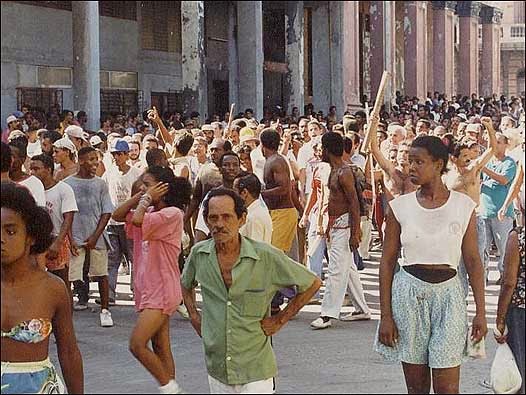
Maleconazo: Mass protests in Havana, Cuba on August 5, 1994
Yoani Sánchez makes an important observation above the regimes in China and Cuba want to erase the inconvenient facts and historical events that are in conflict with the official narrative. Tiananmen Square and the Maleconazo are two such episodes that have important anniversaries in 2014. The massacre in Tiananmen was 25 years ago on June 4, 1989 and the Maleconazo marks 20 years on August 5, 1994. 

Notes from the Cuban Exile Quarter describes below what happened on August 5, 1994 and its historic importance:
500 Cubans gathered on August 5, 1994 on the pier "de la Luz", to take the launch that goes to Regla and Casablanca because there was a rumor that it would again be diverted to Florida. It was a rumor of a path to freedom that these 500 people had seized upon. Military trucks arrived and announced the suspension of the launches departure and dispersed the crowd.  People walking along the Malecón (The Havana Sea Wall)  joined the dispersed crowd and gathered near the  Castillo de la Real Fuerza (Castle of the Royal Force). A thousand Cubans began to march shouting Freedom through the streets of Havana.  That 500 Cubans would gather to flee the island is not a new phenomenon but that another 500 would join them  to march and call for freedom was something new and an unexpected development for the security services.  After marching for a kilometer, a hundred Special Brigade members and plain clothes police confronted the protesters. The demonstrators dispersed into the neighborhood of Central Havana, burning rubbish bins, smashing the windows of the dollar stores and clashing with the police with stones and sticks. Regime agents responded with physical beat downs, several gun shots and their own mobilization of repressive actors.
One thousands Cubans marching through Havana chanting "Freedom!" and "Down with Castro"  The sounds and images of that day have been captured on video and its impact is felt two decades later in music and art.


 It is also important that the images of plain clothes state security aiming their guns at an unarmed protest in a manner that indicates they were shooting must also be remembered and widely distributed.

Maleconazo: Regime agents aiming their guns at protesters
It is also important to recall on the evening of August 5, 1994, the dictator, Fidel Castro took to the airwaves to justify and defend the "13 de Marzo" tugboat massacre that had taken place on July 13, 1994.